Agricultural buildings have different roofing requirements from a typical home.
A farm shed, workshop, equipment store or agricultural building may be exposed to dust, wind, rain, temperature changes and long periods without maintenance.
At the same time, the roof often needs to be practical and cost-effective.
That makes the choice of roof sheeting important.
What Types of Agricultural Buildings Need Roof Sheeting?
The term “farm building” covers a wide range of structures.
You could be roofing:
- Equipment sheds
- Workshops
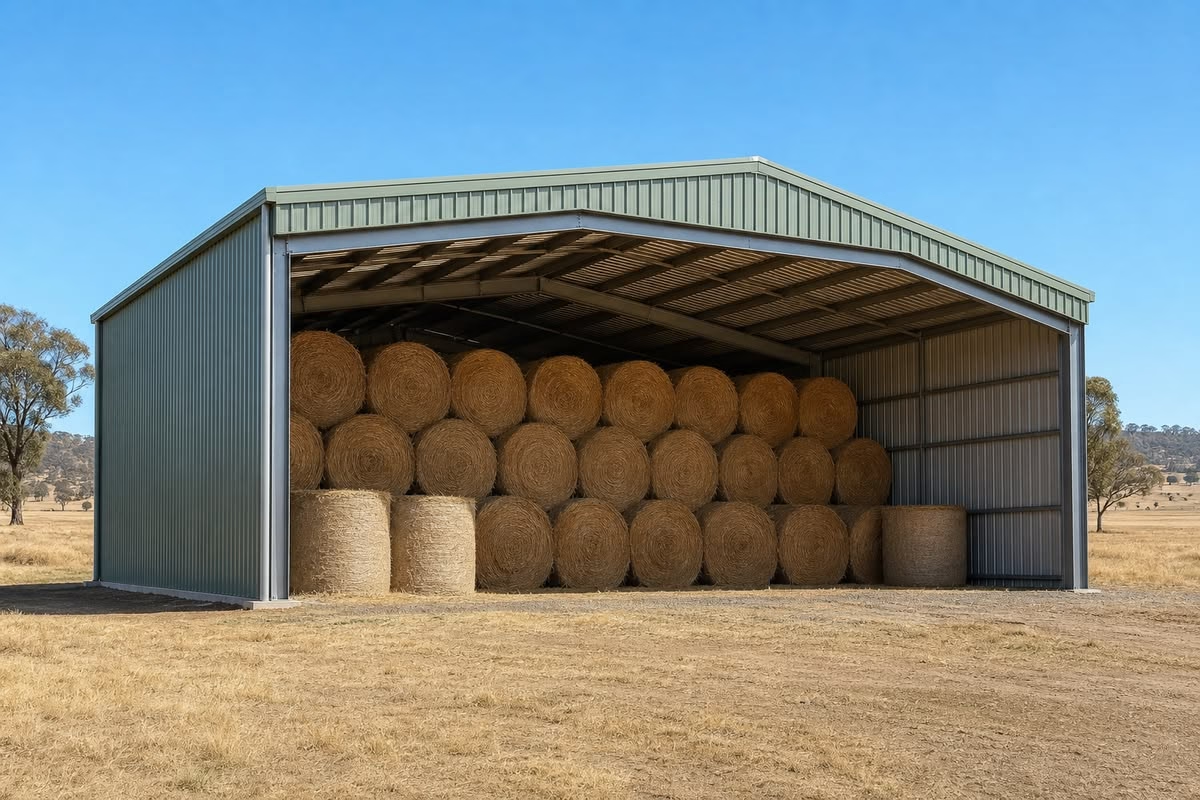
- Hay storage buildings
- Agricultural storage
- Machinery shelters
- Livestock structures
- Farm garages
- General-purpose sheds
- Storage buildings
The right roofing specification depends on the actual use of the building.
A machinery workshop may have very different requirements from an open-sided storage shed.
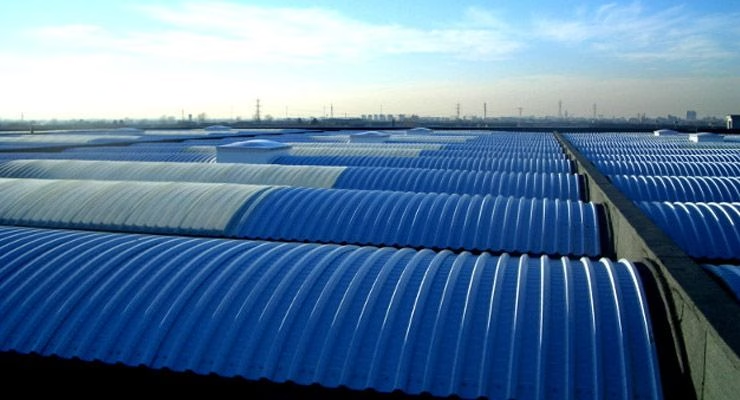
Corrugated Roof Sheeting for Agricultural Buildings
Corrugated steel roofing has been used extensively in agricultural applications because of its familiar profile, relatively simple installation and versatility.
Clotan Steel describes corrugated sheeting as a traditional S-Rib profile used for roofing and cladding, with applications across different building types.
For some agricultural projects, Corrugated can therefore be a practical option.
But it should still be selected according to the roof’s pitch, structure, environment and intended use.
IBR Roof Sheeting for Farm Workshops
IBR is another common option.
Its deeper trapezoidal profile provides different structural characteristics from corrugated sheeting.
Safintra describes IBR as a profile widely used in commercial and industrial construction, with deep flutes that provide drainage characteristics and useful load/span performance.
For agricultural workshops, equipment sheds and more substantial farm buildings, IBR may be worth considering where its characteristics align with the project.
What About Widespan?
Large agricultural structures can make roof coverage particularly important.
Widespan’s wider effective cover can be useful when the roof area is substantial.
Safintra’s Widedek information notes that the wider cover can reduce the number of sheets required compared with narrower profiles, while the profile offers greater spanning capability than traditional sinusoidal corrugated sheeting.
For large agricultural sheds, this can make Widespan a useful profile to investigate alongside IBR and Corrugated.
Galvanised vs Chromadek for Agricultural Buildings
The finish is another decision.
Galvanised roofing provides a zinc coating intended to protect the steel against corrosion.
Chromadek combines steel with a factory-applied painted finish.
The right choice depends on:
- Building purpose
- Appearance
- Budget
- Environmental exposure
- Desired maintenance profile
- Project lifespan
For a basic storage structure, the priorities may be different from those of a high-visibility agricultural development.
Roof Pitch Matters
One of the easiest mistakes to make is treating all roofing profiles as though they can be installed at the same pitch.
They cannot.
Manufacturer specifications provide minimum pitch recommendations for different profiles.
For example, Clotan Steel specifies a minimum IBR pitch of 5° for slopes under 30m and 7.5° for longer slopes.
The exact project specification must be checked before construction.
A roof that is too shallow for its profile can create drainage and waterproofing problems.
Consider the Building’s Exposure
Agricultural buildings can be located in relatively exposed environments.
Think about:
- Wind
- Rain
- Hail
- Dust
- Temperature
- Sun exposure
- Corrosive environments
- Maintenance access
The roofing material is only one part of the system.
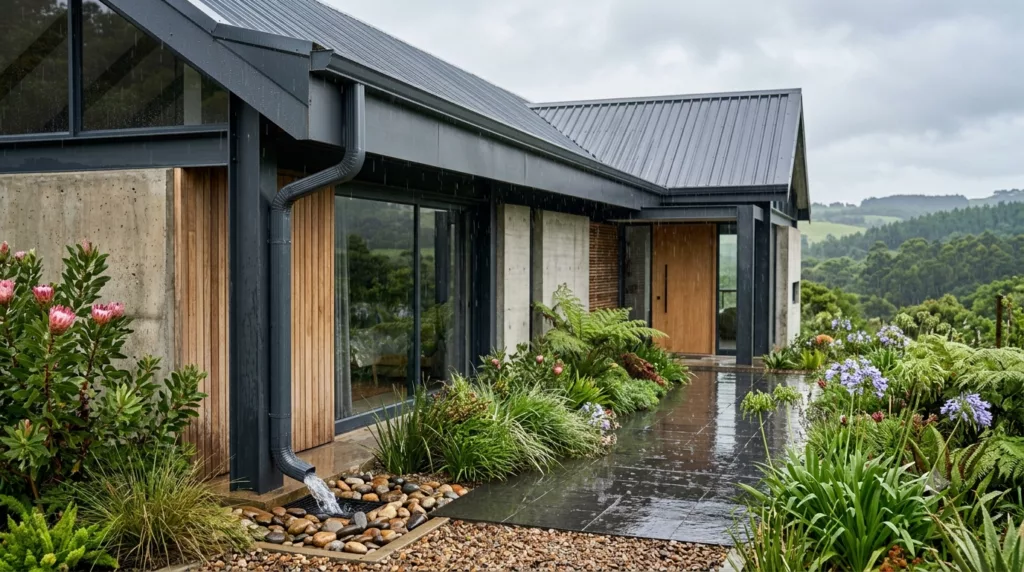
The roof structure, purlins, fixings, flashings and drainage all need to work together.
Don’t Forget the Flashings
Farm buildings are sometimes treated as though they don’t need the same level of detailing as residential buildings.
That’s a mistake.
Flashings are still important around:
- Ridges
- Roof edges
- Wall junctions
- Valleys
- Openings
- Penetrations
A roof can have excellent sheets and still develop leaks because the detailing around the edges and junctions is poor.
Roofsheeting Warehouse manufactures galvanised and Chromadek flashings, including ridge, valley, sidewall and corner options.
Custom-Length Sheets Can Help on Large Farm Buildings
Agricultural buildings often have relatively simple roof geometries.
That can make custom-length roofing particularly useful.
Longer correctly specified sheets can potentially reduce unnecessary joins and on-site cutting.
The key is accurate measurement.
Roofsheeting Warehouse manufactures custom roof sheeting in Pretoria and offers IBR, Corrugated and Widespan profiles.
What Should You Give Your Roofing Supplier?
Before requesting a quote, provide:
- Building length
- Building width
- Roof pitch
- Roof type
- Intended use
- Preferred profile
- Steel thickness
- Finish
- Sheet length
- Quantity
- Delivery location
If you are uncertain about the profile, explain what the building will be used for.
A good supplier should be able to ask the right questions before manufacturing or supplying the material.
Example: A Farm Workshop
Imagine a farm workshop measuring 12m × 20m.
The roof might require:
- A suitable steel roofing profile
- Correctly specified thickness
- Appropriate roof pitch
- Purlins designed for the structure
- Roofing fasteners
- Ridge flashing
- Barge or sidewall flashings
- Gutters and downpipes where required
The important point is that the roofing purchase should be planned as a system, not as a pile of sheets.
What About Hail?
For agricultural buildings in areas exposed to significant hail, material selection deserves additional attention.
Thickness, profile, support spacing, fixing and roof design all influence the system’s performance.
It is therefore better to discuss the building’s actual conditions than to assume that one profile or thickness is automatically suitable everywhere.
Frequently Asked Questions
What is the best roof sheeting for a farm shed?
There is no universal answer. Corrugated, IBR and Widespan can all be suitable depending on the building design, roof pitch, span, budget and environmental conditions.
Is IBR suitable for agricultural buildings?
Yes. IBR is widely used across commercial, industrial and agricultural-style applications, provided the complete roofing system is correctly specified.
Is Corrugated cheaper for farm sheds?
Corrugated can be a cost-effective option, but the total project cost depends on thickness, profile, sheet quantity, length, installation and accessories.
Is Widespan suitable for large farm sheds?
It can be. Its wider coverage and structural characteristics make it worth considering for larger agricultural structures.
Can roof sheets be custom cut for farm buildings?
Yes. Roofsheeting Warehouse offers custom roof sheeting and manufactures IBR, Corrugated and Widespan products.
The Bottom Line
Choosing roof sheeting for an agricultural building starts with the building itself.
What will it be used for?
How large is it?
What is the roof pitch?
What environmental conditions will it face?
How much maintenance is practical?
Once those questions are answered, the choice between Corrugated, IBR, Widespan, galvanised and Chromadek becomes much easier.
For a small farm shed, a straightforward roofing solution may be all you need.
For a large workshop, machinery shed or agricultural warehouse, the roofing system deserves more detailed planning.
Building or renovating an agricultural structure? Roofsheeting Warehouse supplies IBR, Corrugated, Widespan, flashings and other roofing materials from Pretoria, with delivery throughout Gauteng.