You have patched the same leaks three summers in a row. The sheets are rusting along the laps, a few screws have lifted, and every storm sends you up the ladder with a tube of sealant. At some point, patching costs more than it saves.
Here is how to replace roof sheets without the job turning into a crisis. First, decide whether you need a few new sheets or a full re-roof, and check whether the old roof contains asbestos.
Inspect the purlins and trusses under the sheets, measure every slope, and order new sheets cut to length in the right profile. Then strip and re-sheet one section at a time, so the building is never left open to the weather.
This guide covers each step, what the materials cost, and the mistakes that turn a re-roof into a much bigger bill.
Repair, partial replacement or a full re-roof?
Start by being honest about what the roof needs.
| What you see | What it usually means | Best move |
|---|---|---|
| One or two dented, holed or rusted sheets | Local damage, for example from hail, a branch or a leaking flue | Replace those sheets |
| A leak at one lap, screw line or flashing | A fixing or flashing problem, not failed sheets | Repair the detail with new screws, sealant or flashing |
| White, powdery marks on galvanised sheets | The zinc coating is corroding, which is its job | Clean, fix drainage and keep watching |
| Red rust on many sheets, worst along laps and screw lines | The zinc has run out in those areas | Plan a large partial or full re-roof |
| Holes, flaking steel, sagging sheets, many leaks | The roof has reached the end of its life | Full re-roof |
| Grey fibre-cement sheets on a building from before 2008 | Possibly asbestos | Stop. See Step 1 before anyone touches it |
Not sure how far gone the rust is? Our guide to rusted roof sheets shows you how to judge it.
How to replace roof sheets in 9 steps
Step 1: Find out what the old roof is made of
Asbestos was banned in South Africa in 2008, so buildings put up before then may still contain it (The Citizen). If your sheets are grey, thick and cement-like rather than thin steel, treat them as possible asbestos until a competent person says otherwise. Do not drill, cut, grind or pressure-wash them.
Removal is regulated and must be done by a registered asbestos contractor. Our guide to asbestos roof replacement explains the rules.
If the roof is steel, identify the profile so the new sheets match:
| Profile | How to recognise it | Cover width |
|---|---|---|
| IBR | Square, flat-topped ribs at 171.5 mm centres, 37 mm high | 686 mm |
| Corrugated | Rounded, wave-shaped corrugations at 76 mm centres, 17.5 mm high | 762 mm |
| Widespan | Square-fluted like IBR, but with shallower ribs | 762 mm |
IBR and Corrugated dimensions are from the GRS Corrugated and IBR 686 specifications. If you are replacing only some sheets, measure the rib centres on the old roof. Older sheets do not always match current profiles, so bring a photo with a tape measure across the ribs, or a small offcut, when you order.
Step 2: Inspect the structure under the sheets
Purlins (the horizontal members the sheets are fixed to) and the trusses or rafters below them carry the whole roof. When the old sheets come off, check:
- Timber for rot, borer holes and splits, especially at the eaves and around old leaks.
- Steel purlins for rust and bent flanges.
- That trusses and rafters are still properly tied down to the walls.
- That the purlin spacing suits your new sheets, using the manufacturer’s span table for the profile and thickness you are buying.
If you are changing from heavy concrete tiles to steel, the roof becomes far lighter. Light roofs are more prone to lifting in strong wind, so tie-downs matter more than ever.
Ask an engineer to check the structure and anchorage first. Our comparison of roof tiles vs roof sheeting explains the weight difference in detail.
Step 3: Check whether you need approval
Building work in South Africa falls under the National Building Regulations and Building Standards Act 103 of 1977. Part L of the regulations covers roofs, and a roof is deemed to comply if it follows SANS 10400-L (National Building Regulations, Part L).
Whether your job needs approved plans depends on its scope and on your municipality. Speak to your local building control office, for example in the City of Tshwane, Johannesburg or Ekurhuleni, before you change the roof structure, the roof shape or the type of covering. Estate rules and homeowners’ associations may also control roof colour.
This guide is not legal advice. For anything structural, speak to a registered engineer or architect.
Step 4: Measure every slope
For each slope, measure:
- The width along the eaves, to work out how many sheets you need.
- The length from the ridge to the eaves, plus the overhang into the gutter.
Number of sheets = slope width divided by cover width, rounded up. On a 12 m wide slope, that is 18 IBR sheets (12 divided by 0.686 is 17.5) or 16 Corrugated sheets (12 divided by 0.762 is 15.7).
Order one length per slope wherever you can. We roll sheets up to 13 m long, so most house roofs need no end laps at all.
Step 5: Choose your sheet, thickness and finish
- Profile: match the existing roof if you are replacing only part of it. On a full re-roof you can change profile, as long as the pitch and purlin spacing suit the new one.
- Thickness: match it to your purlin spacing and use. We stock galvanised sheets from 0.3 mm to 0.5 mm, and Chromadek® at 0.5 mm.
- Finish: galvanised (zinc-coated) or Chromadek® (factory-painted over a galvanised base), in Dove Grey, Fish Eagle White, Gemsbok, Kalahari Red, Buffalo Brown, Charcoal, Sandstone Beige and Traffic Green.
Based on our online shop prices on 19 October 2026, here is roughly what the sheets cost per square metre of roof:
| Sheet | Galvanised | Chromadek® 0.5 mm |
|---|---|---|
| IBR (686 mm cover) | about R108 to R162 per m² | about R227 per m² |
| Corrugated or Widespan (762 mm cover) | about R97 to R146 per m² | about R205 per m² |
These figures cover the sheets only, before laps, waste, screws, flashings and labour. Prices move with coil costs and the rand, so always check the current price.
Have your measurements? Send them through our quote form and we will price the sheets, screws and flashings in one clear quote.
Step 6: Plan the job so the building is never open
- Strip and re-sheet one section at a time, and close each section the same day.
- Have the new sheets on site before the old ones come off.
- Watch the forecast. Summer storms in Gauteng often build in the afternoon, so start early and aim to close up by early afternoon.
- Cover ceilings and contents below with plastic sheeting.
Step 7: Remove the old sheets safely
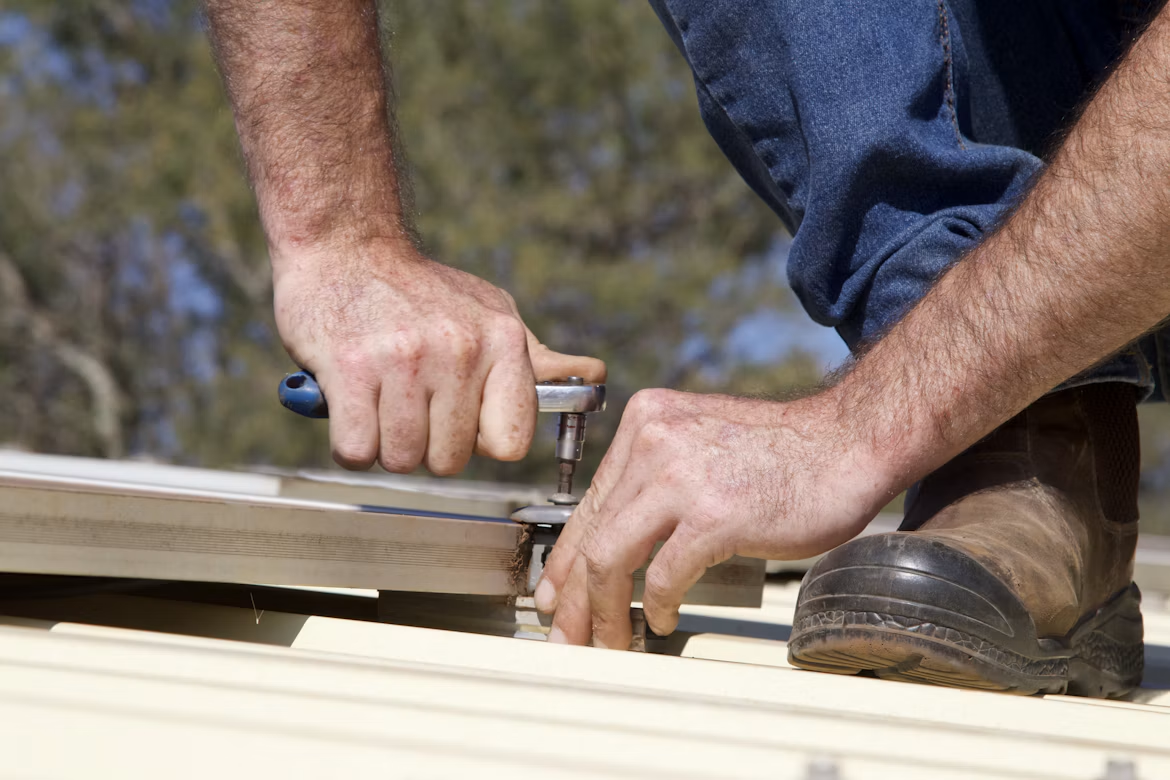
Unscrew or cut the old fixings, lift each sheet clear and lower it down. Never throw sheets off a roof. Work from the purlin lines, use fall protection, and wear gloves, because old sheet edges are sharp.
Old steel sheets are worth something as scrap. Light and sheet steel was fetching roughly R1.20 to R2.40 per kg at Johannesburg scrap yards in July 2026 (Scrap Metal Joburg).
Clotan lists 0.5 mm IBR at 3.718 kg per metre, so eighteen old 6 m sheets weigh roughly 400 kg. At those rates, that is roughly R480 to R960, less if the sheets are badly rusted.
Step 8: Fit the new sheets
The process is the same as on a new roof: start at the end away from the prevailing wind, lay the side laps the right way round, fix through the ribs into every purlin, seal end laps on low pitches, and form stop ends and drips. Our step-by-step guide on how to install IBR roof sheeting covers every stage.
Step 9: Replace flashings, closures and screws at the same time
New sheets under old flashings are a false economy. Old flashings may be rusted, bent or made for a different profile, and they are a common leak point.
Replace the ridge, barge, sidewall and headwall flashings, fit new closures, and never reuse old screws. While access is easy, check the gutters and downpipes too. We bend flashings to your measurements and stock gutters and downpipes, so everything arrives together.
What does it cost to replace roof sheets?
A re-roof budget has six parts:
- Sheets.
- Screws, closures and sealing strip.
- Flashings, gutters and downpipes.
- Labour and safe access, such as scaffolding.
- Removal and disposal of the old roof, including a registered contractor if it contains asbestos.
- Structural repairs, such as rotten purlins or missing tie-downs.
Example: a 100 m² roof in Chromadek® IBR at about R227 per m² comes to roughly R22 700 for the sheets alone. In 0.5 mm galvanised IBR, at about R162 per m², it is roughly R16 200. Add the other five parts on top.
For labour, get two or three written quotes and check that each one includes removal, disposal, flashings and making good. Our online shop also offers PayJustNow, so you can pay for materials in three interest-free instalments.
Mistakes that make re-roofing expensive
- Stripping the whole roof at once, then racing a storm.
- Ordering before measuring the actual roof, rather than working from old plans.
- Ignoring rotten purlins because the new sheets will hide them.
- Mixing profiles on one slope, which leaves gaps at the laps.
- Reusing old flashings and screws to save a few hundred rand.
- Touching suspected asbestos without an assessment.
- Skipping the approval check when the structure or covering type changes.
Frequently asked questions
Can I replace just one roof sheet?
Yes, if the rest of the roof is sound. Remove the screws in the damaged sheet and along both side laps, slide it out, and fit a new sheet of the same profile and cover width with new screws.
Can I put new roof sheets over the old ones?
We do not recommend it on steel roofs, because you cannot inspect the purlins or trusses underneath and moisture can be trapped between the layers. On asbestos roofs, a 2024 amendment to the regulations prohibits making any installation or fitting onto asbestos-containing material.
Do I need building plans to replace my roof?
It depends on the scope and your municipality. Changing the structure, roof shape or covering type is more likely to need approval than a like-for-like sheet swap, so check with your local building control office first.
Will new sheets match my old roof?
Usually, if the old roof is a standard IBR, Corrugated or Widespan profile. Bring a photo with a tape measure across the ribs, or an offcut, so we can confirm before we roll.
What should I do with the old sheets?
Steel sheets can go to a scrap metal dealer. Asbestos sheets must be removed and disposed of by a registered asbestos contractor.
Ready to re-roof? Request a quote with your measurements and photos, or visit our Pretoria warehouse. We will roll your sheets to length and supply the flashings, screws and gutters to finish the job.
Reviewed by the Roofsheeting Warehouse team in Pretoria, steel roofing suppliers since 2002 and roll-forming IBR, Corrugated and Widespan in-house since 2010.