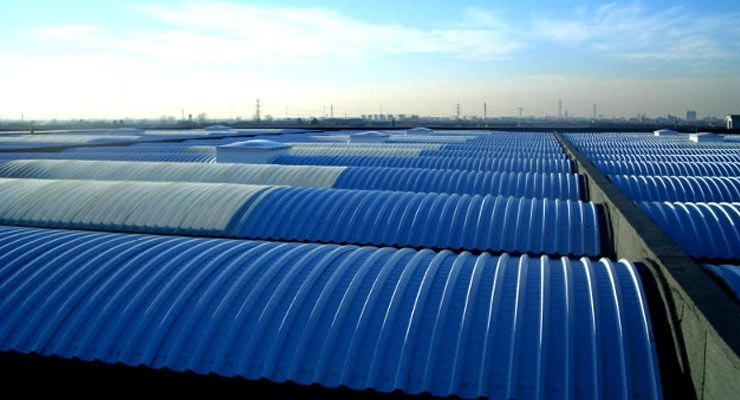
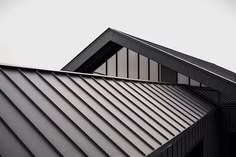
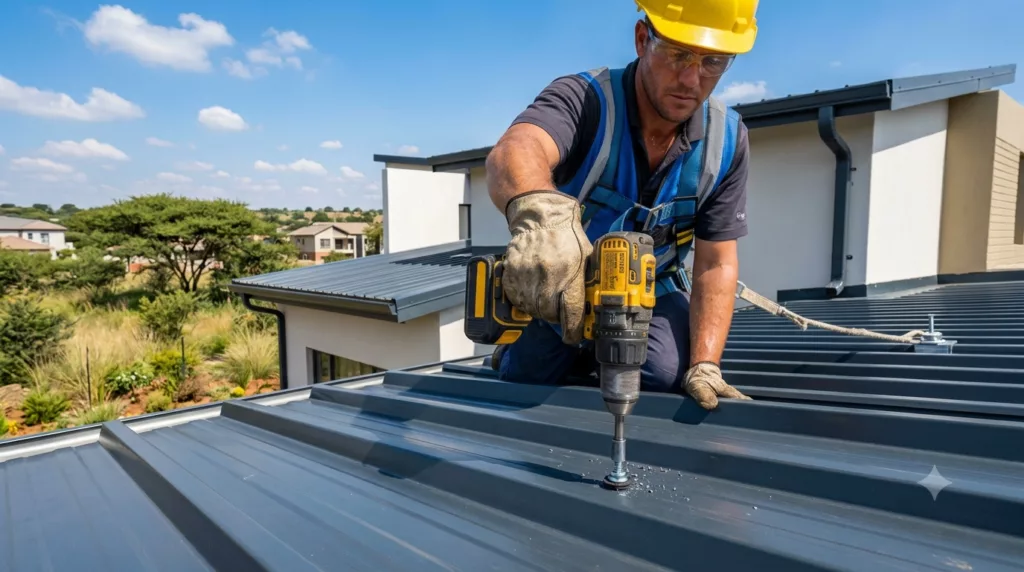
Sipho the weekend warrior just bought 50 m² worth of patio dreams… and a healthy fear of SANS inspectors. If you’re eyeing a steel-roof add-on—garage, granny flat, pizza-oven pavilion—this guide walks you through the six key decisions that separate a watertight triumph from a slow-drip disaster.
1. Nail the Numbers: Pitch First, Pretty Later
A steel roof leaks not because Chromadek® is “bad”, but because someone built it flatter than a braai grid.
| Profile | Min Pitch (°) | Rise per metre | Source |
|---|---|---|---|
| IBR ≤ 20 m sheets | 5° | 87 mm | (media.autospec.com) |
| IBR > 30 m sheets | 7.5° | 131 mm | (media.autospec.com) |
| Corrugated ≤ 15 m | 7.5° | 131 mm |
Quick calc: Rise = tan (pitch) × run. Online pitch widgets (think OmniCalculator) give instant results and rafter lengths. omnicalculator.com
Why it matters: SANS 10400-L lets you dip to 5° only if every end-lap is sealed and ≥ 250 mm—skip that and your insurer may ghost you faster than a bad Tinder date. (ndlambe.gov.za)
2. Mind the Skeleton: Purlins, Lip-Channels & Engineer Sign-off
- Span reality check: A 150 mm lip-channel comfortably spans 6 m; space them ± 1,5 m apart. (4x4community.co.za)
- Timber vs. steel trusses: Timber’s lighter on the pocket, but if you’re bolting a flat carport to masonry, cold-formed steel can shave height and weight.
- Engineer’s letter: Required for any new roofing over 10 m² if you want plans approved in Tshwane. (Yes, the city reinspect trusses now—ask anyone who queued at Munitoria.)
DIY threshold: If you need to cut or notch structural members—dial a pro; SANS and the banks both insist.
3. Sheet Metal Match-Up: Thickness, Profile, Length
| Good | Better | Best |
|---|---|---|
| 0.40 mm Corrugated (budget sheds) | 0.47 mm IBR (home extensions) | 0.53 mm IBR / Klip-Lok (hail & solar-ready) |
Tip: Keep single-run lengths ≤ 20 m to avoid extra end-laps—your back (and sealant budget) will thank you. (media.autospec.com)
4. Watertight by Design: Flashings, Washers & Sealant
- EPDM-bonded screws every second valley on edges, every third in the field.
- Butyl end-lap tape under all joins; clamp down before midday heat sets the adhesive.
- Full-width ridge closures—rodent-proof and hail-deflecting.
Skimping here is why forum threads titled “Anybody with sage roofing advice?” keep popping up. (4x4community.co.za)
5. Comfort Counts: Insulation & Condensation Control
Pretoria summers hit 32 °C; metal amplifies unless you…
- Lay a 135 mm glass-wool blanket (R-3.5) on the ceiling joists.
- Add a foil-faced vapour barrier if your extension doubles as a kitchen or laundry.
- Pop two whirly-birds per 100 m²—they’re cheap, silent and SANS-friendly.
Bonus: blankets mute rain by 10-15 dB, so no marimba solos when storms roll in. (omnicalculator.com)
6. DIY vs Pro—Where the Line Really Is
| Task | Safe DIY? | Why / Why Not |
|---|---|---|
| Measure pitch, order sheets | ✅ | Calculator + laser level = foolproof. |
| Screw-down & sealing | ⚖️ Maybe | OK if < 3 m high, no hips/valleys. |
| Structural mods (truss, wall plate) | ❌ | Needs engineer stamp, NHBRC sign-off. |
| Waterproof flashing around chimneys/solar | ⚖️ | Easy to botch, costs a ceiling later. |
| City plan submission | ❌ | So much paperwork—save your sanity. |
Rule of thumb: If gravity or SANS fines can hurt you, dial a pro.
Case-Study Sidebar: Sipho’s Patio Win
Sipho (a Pretoria East engineer) DIY-managed his 6 m × 8 m patio roof:
- Calculated a 5° pitch → 450 mm rise (used OmniCalculator).
- Ordered 0.47 mm IBR at 6 m lengths—no end-laps.
- Hired a roofing crew for a one-day screw-down.
- Total cost: R31 k—40 % under a turn-key quote. Zero leaks after two rainy seasons. mybroadband.co.za
Ready to Build a Roof the SANS Inspector Wishes He’d Signed Off?
From engineering letters to sheet cutting, flashings and on-site coaching, we’re Pretoria’s one-stop launchpad for DIYers and time-starved pros alike.
👉 [Book your free “Pitch & Plan” session] and leave the drips, dips, and doldrums to someone else.